

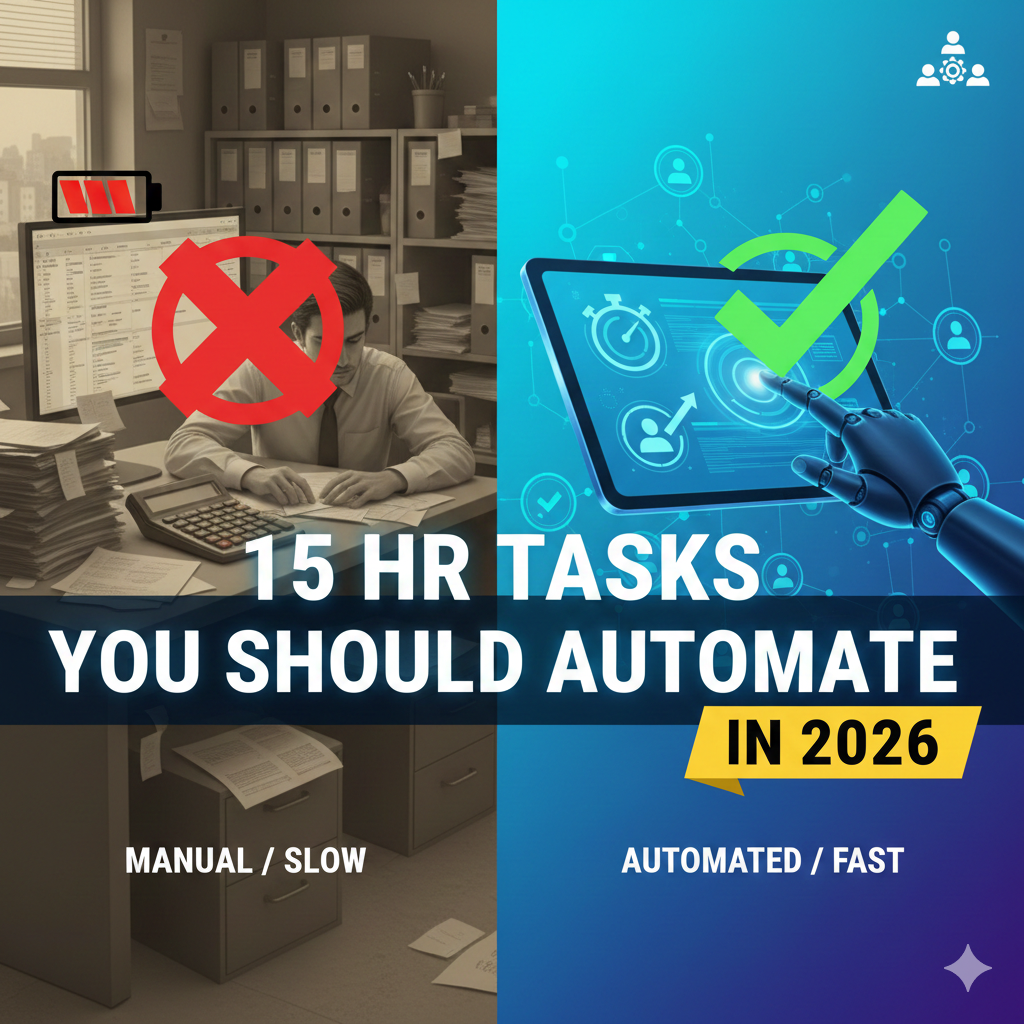
HR is an industry in flux. No longer is HR defined simply by filing cabinets and paper trails. In 2026, the emphasis is on people strategy, culture and the employee experience. Unfortunately, many teams are still overwhelmed by repetitive administrative HR tasks that take up valuable hours. Here, automation becomes a force multiplier.
Using technology to carry out routine operations allows an organization to substantially minimize mistakes, maintain compliance, and liberate its workforce. With automation, professionals can devote their attention to the kinds initiatives and tasks that transform core functions.
These are 15 particular areas of HR tasks that you should be automating to enhance performance and increase organizational effectiveness.
Why Automation is Essential for Modern HR
It is essential to comprehend the ‘why’ part before getting straight to the to-do list. It is not only slow manual processing also has its risks. Losing money is one thing, but an input error in payroll or compliance reporting can cause major dissatisfaction among employees. Automation is not only about increasing productivity, but also about the employee experience. Automation improves the experience and digitalizes engagements employees expect in their everyday lives.
15 HR Functions Primed for Automation
-
Payroll Processing
Payroll is in all likelihood the most important but also one of the most tiresome executions one will come across in an enterprise. It is tedious, complex and is susceptible to numerous human errors. Incorrect payroll processing can result in erosion of trust, and employee dissatisfaction can result in major dissatisfaction among the organization. Payroll processing systems automate and optimize the processing of payroll, tax and deduction calculations, and payroll allocations so that every paycheck delivered is on-time.
-
Employee Onboarding
Onboarding is the most important process among all, and automation will help in the elimination of all the tedious and tiresome manual processes. First impressions matter. In the absence of an automated system for onboarding, HR risks lost paperwork along with a great deal of manual processing and new hire confusion. Igniting automation in this process will make the entire journey of a new hire feel streamlined and to make them feel welcome and prepared on their first day.
-
Recruitment and Applicant Tracking
Going through hundreds of resumes by hand is highly inefficient. Applicant Tracking Systems are designed to filter resumes based on certain criteria and screen resumes. ATS can also schedule interviews and send automated follow-up emails so candidates do not fall unattended.
-
Time and Attendance Tracking
Screen paper timesheets and spreadsheets are a thing of the past. Employees can clock in through apps or biometric scanners, and automated time-tracking software records this in real time. This directly syncs to your payroll systems to eliminate manual entry, time-theft as well as calculation discrepancies.
-
Leave and Absence Management
Tracking holiday requests by email is a proven disaster. Automated leave management systems empower your employees to view their balance, and request time off through self-service portals. Managers can approve requests in one click, team calendars are updated in unison so everyone stays informed.
-
Performance Reviews
The annual sit down review has traditionally resembled a web of chaos, endless forms and conflicts in scheduling. Automation platforms simplify the process by managing review cycles, distributing feedback forms, and compiling results into user-friendly collated reports. This lends itself to a more frequent and meaningful review process.
-
Benefits Administration
The complexity of managing health insurance, retirement plans, and other benefits is made easier through automation. Self-service benefits administration portals allow employees and staff members to select and manage all benefits during open enrollment. The automation system manages transferring enrollment data to providers which increases accuracy and lowers the administrative burden on the HR department.
-
Compliance and Reporting
Keeping up with labor laws is one of the most stressful tasks and responsibilities an hr manager has. Compliance automation tools track changes in the legislation and update your systems. The tools can also generate mandatory reports and file them with the government so as to avoid missed deadlines or costly fines for non-compliance.
-
Learning and Development (L&D)
There is a lot of inefficiency in the manual assignment of training modules. A Learning Management System (LMS) is capable of assigning all mandatory trainings based on employees’ roles, tracking completion, and awarding completion certificates. This way, your workforce is always kept up-to-date and compliant with their assigned tasks and training without the need of constant supervision.
-
Employee Offboarding
Security and asset recovery is a top priority for an employee’s termination. Automated offboarding workflows allow for the timely and efficient cancelation of access rights, arrangement of exit interviews, and the returning of company property. This process protects the company and ensures a well-organized offboarding for all employees.
-
Employment Contract Generation
New hires need to sign employment contracts, and making a unique contract for every new hire is tedious and inefficient. Contract automation is becoming common and is useful because it extracts information from your recruitment system and fills it into appropriate templates and it is also useful in ensuring legal accuracy in numerous documents at a time, Finally, it adds efficiency to the hiring process.
-
Expense Management
Everyone hates processing large volumes of receipts. Modern expense management systems let users simply take photos of receipts on their mobile devices and claim expenses through streamlined mobile apps. The system automatically sorts expenses into the right categories, checks them against company policies, and sends them to the right approvers.
-
Employee Satisfaction Surveys
To keep employees satisfied, you must understand how they feel about their jobs. Manual surveys are outdated, and automation tools now conduct periodic pulse surveys without requiring direct interaction. These tools also summarize the data instantly, giving managers useful insights right away.
-
Internal Communications
Everyone needs to stay in the loop without you manually sending emails. Automated internal communication tools let you pre-schedule messages for teams, ensuring communication continues smoothly without your constant involvement. These tools help employees feel connected and support a positive workplace culture.
-
Employee Data Management
An HR fundamental necessity is keeping records up to date. In the case of self-service portals, employees can modify their personnel records, for instance, change of address or update emergency contact. This allows HR to not have to update change-request forms to keep the database current.
Conclusion
By 2026, the gap between administrative processing and strategic leadership will continue to widen. The time and error saving benefits of automating these 15 hr tasks is noticeably raising the entire function of Human Resources. Automation is enabling your team to concentrate on what truly matters; developing an engaged, productive, and thriving workforce.
You should assess your current processes. Determine the bottlenecks in your workflow. Some HRM Software & Automation tools exist to streamline these tasks, and your team—and bottom line—will appreciate the benefits.


